
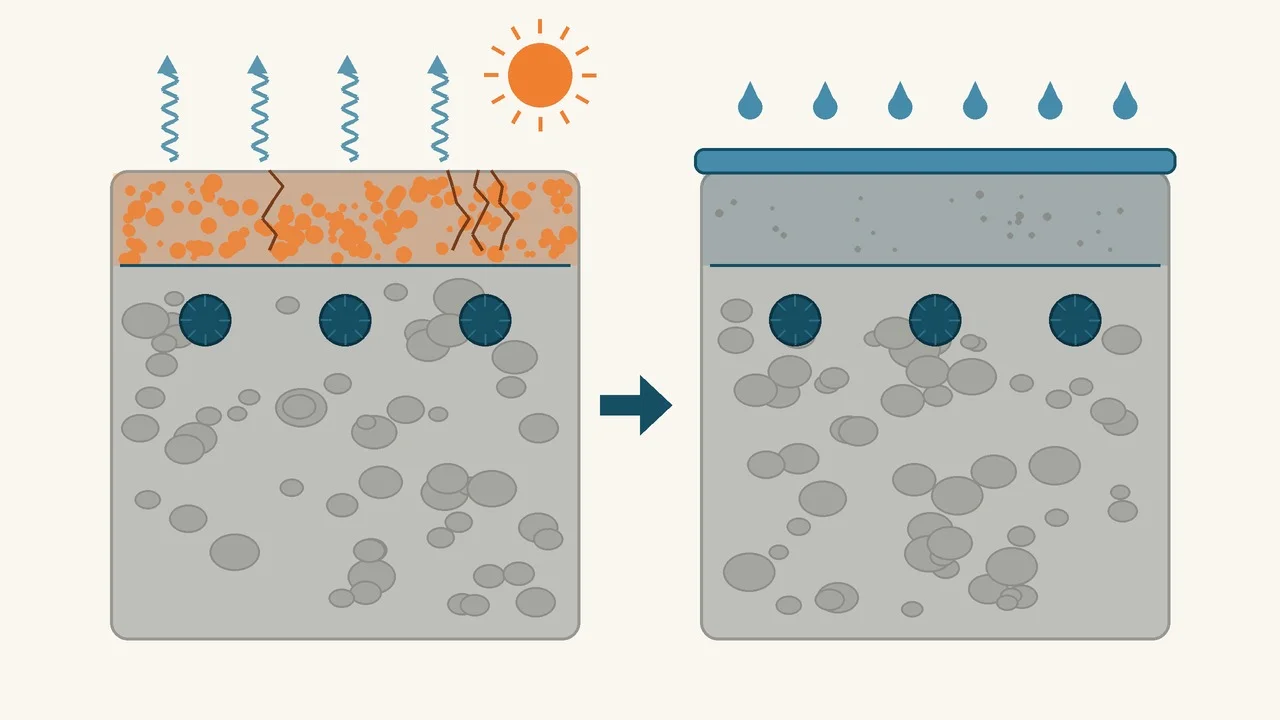
The specimen cast on the job goes to the moist room and is tested to failure under standard conditions. The cover of the structure does not. It stays exposed to the sun, the wind and dry air, sometimes only a few hours after placement. A good compressive-strength result does not prove that the member was well cured, much less that the concrete at the surface will have the durability assumed in the design.
The surface is where curing matters most
ACI 308R-01 (Guide to Curing Concrete), from the American Concrete Institute, describes concrete as most sensitive to moisture loss, and therefore most sensitive and responsive to curing, right at the surface, where it is in contact with moving dry air or with absorbent materials, such as a dry subgrade or porous formwork (item 1.5).
The guide cites an example from Hanson (1968): 150 x 300 mm cylinders, moist cured for 7 days and then dried at 23 °C and 50% relative humidity. At 28 days, the internal relative humidity 6.4 mm from the face was about 70%, while at the center of the cylinder it was about 95%. Under that condition, the cement in the outer layer would already have stopped hydrating, while the cement at the center would still be hydrating.
From Cather (1992), ACI 308R-01 calls this layer the curing-affected zone: the part of the concrete most influenced by the curing measures, running from the surface to a depth of approximately 5 to 20 mm, depending on the water/cementitious materials ratio, the permeability and the ambient conditions. In practice, it is the outer part of the cover, the first barrier between the environment and the reinforcement.
Why compression misleads
The same item 1.5 of the guide lists the properties strongly influenced by curing: surface hardness, abrasion and scaling resistance, surface permeability and absorption, flexural tensile strength and surface cracking, among others. It also notes that conventional compression tests on cylinders, cubes or cores indicate the strength of the interior of the specimen, but are not necessarily representative of the surface properties. The curing-affected zone is not critical to the failure of the cylinder, which occurs away from the ends. In an extracted core, that layer is usually capped, ground or sawn off.
How the duration of curing changes the surface
In item 1.6, the guide brings together data from different sources:
- extending moist curing from 1 to 3 days reduced permeability by 50%, with a similar improvement when the period was extended again to 7 days;
- extending water curing from 1 to 4 days reduced surface absorption by about 50% (Dhir, Hewlett and Chan, 1987).
In item 2.9, ACI 308R-01 draws an important distinction: for concretes with and without pozzolans, a minimum curing period of 7 days will often be enough to reach about 70% of the specified strength, but it is not necessarily true that durability properties, such as abrasion resistance or surface absorption, reach satisfactory levels in the same time. The duration required depends on the composition and the fineness of the cementitious materials, the water/cementitious materials ratio, the mix, the admixtures and additions, the temperature and the efficiency of the curing method. When absorption, permeability or another durability property is a requirement, curing may have to be extended until the required values are reached, and it is for the designer and the specifier to define which properties are critical and how to verify them.
For mass concrete, the guide is explicit about the additions: in unreinforced massive sections without ground granulated blast-furnace slag or pozzolan, cure for at least 2 weeks; with slag or pozzolan, for at least 3 weeks (item 3.3.2).
A Brazilian result with CP III
In the master’s dissertation of Epaminondas Luiz Ferreira Junior (Unicamp, 2003, advisor Gladis Camarini), concretes made with Portland blast-furnace cement (CP III, the Brazilian designation) and with high-early-strength Portland cement (CP V-ARI) were subjected to four curing regimes: standard curing, immersion in water for 7 days, curing in air, and thermal curing (60 °C and 80 °C). Durability was assessed by capillary absorption, air permeability, natural and accelerated carbonation, and chloride penetration.
According to the abstract of the work:
- immersion curing in water for up to 7 days gave results similar to standard curing for all the properties studied;
- the worst results, both mechanical and of durability, came from the specimens cured in air, and were more harmful in the concretes with CP III;
- thermal curing greatly improved the early strength of the concretes with CP III, mainly at 80 °C, with no significant gain for CP V-ARI;
- the concretes with CP V-ARI performed well in carbonation, but had higher absorption and chloride penetration.
The author’s conclusion sums up the point: a suitable curing regime is essential to secure mechanical strength and durability, and mechanical strength cannot be used as a durability parameter.
What the Brazilian standard says
Brazilian standard ABNT NBR 14931:2004 (Execution of concrete structures), in item 10.1, requires surface structural elements to be cured until they reach a characteristic compressive strength (fck), in accordance with ABNT NBR 12655, equal to or greater than 15 MPa. It is a strength criterion, not a calendar one. And, as the data above show, it is a minimum: meeting the strength criterion does not, by itself, guarantee the quality of the surface layer.
In practice
Start curing as soon as the surface allows, without waiting until the next day. Treat the duration of curing as part of the specification, not as a site habit. With slag cements, a lack of curing costs more. When the durability of the cover is a requirement, as in aggressive environments, set the duration from a test of the property that matters (absorption, permeability), not from the specimen fck alone.
References
- ACI COMMITTEE 308. ACI 308R-01: Guide to Curing Concrete. Farmington Hills: American Concrete Institute, 2001. Items 1.5, 1.6, 2.9 and 3.3.2. Document superseded by ACI 308R-16 (Guide to External Curing of Concrete), according to the official preview: https://www.concrete.org/Portals/0/Files/PDF/Previews/308R_16_preview.pdf
- FERREIRA JUNIOR, Epaminondas Luiz. Avaliação de propriedades de concretos de cimento Portland de alto-forno e cimento Portland de alta resistência inicial submetidos a diferentes condições de cura (Evaluation of the properties of concretes made with Portland blast-furnace cement and high-early-strength Portland cement under different curing conditions). 2003. 141 p. Dissertation (M.Sc.), Faculdade de Engenharia Civil, Universidade Estadual de Campinas, Campinas, 2003. Advisor: Gladis Camarini. Available at: https://hdl.handle.net/20.500.12733/1597209. BDTD record: https://bdtd.ibict.br/vufind/Record/UNICAMP-30_faddd5c2d921ff17da059b17c4e36db4
- ABNT. NBR 14931: Execution of concrete structures: Procedure. Rio de Janeiro: ABNT, 2004. Item 10.1.