
Every dam, foundation block or concrete pavement that opens a map crack after a few years raises the same suspicion: alkali–aggregate reaction. In Brazilian practice the set of mechanisms is called RAA. The common form is alkali-silica reaction, ASR. It is slow, quiet, and once it is established there is no simple repair. The useful conversation happens before the first batch, in the choice of aggregate, cement and supplementary cementitious material.
Three conditions, one gel
ASR needs three things at the same time:
- Aggregate with reactive silica — poorly crystalline or strained silica that dissolves in a strongly alkaline pore solution.
- High alkalinity in the pore solution — sodium and potassium, mostly from the cement, keep the pH very high and a large reserve of hydroxyl available.
- Moisture — without water the gel neither forms nor swells.
Hydroxyl attacks the silica of the aggregate; sodium, potassium and calcium enter the structure and an alkali-silica gel forms. The gel takes up water and expands inside the aggregate and in the interfacial transition zone. The pressure cracks the aggregate and the paste. On the member the signs are map cracking, gel exudation, movement and a loss of stiffness. Rajabipour and co-authors (2015) note that several steps of the mechanism are still debated. The consensus is that removing any one of the three conditions stops the process.
In practice, moisture is not controlled in a foundation or a dam, and the aggregate is what the region offers. What remains is the chemistry of the paste. That is where the SCMs come in.
How an SCM mitigates
Three effects act together.
Dilution. Replacing part of the cement with a low-alkali SCM reduces the total alkali that enters the concrete. It is the simplest effect, and on its own it does not explain the performance of the more effective materials.
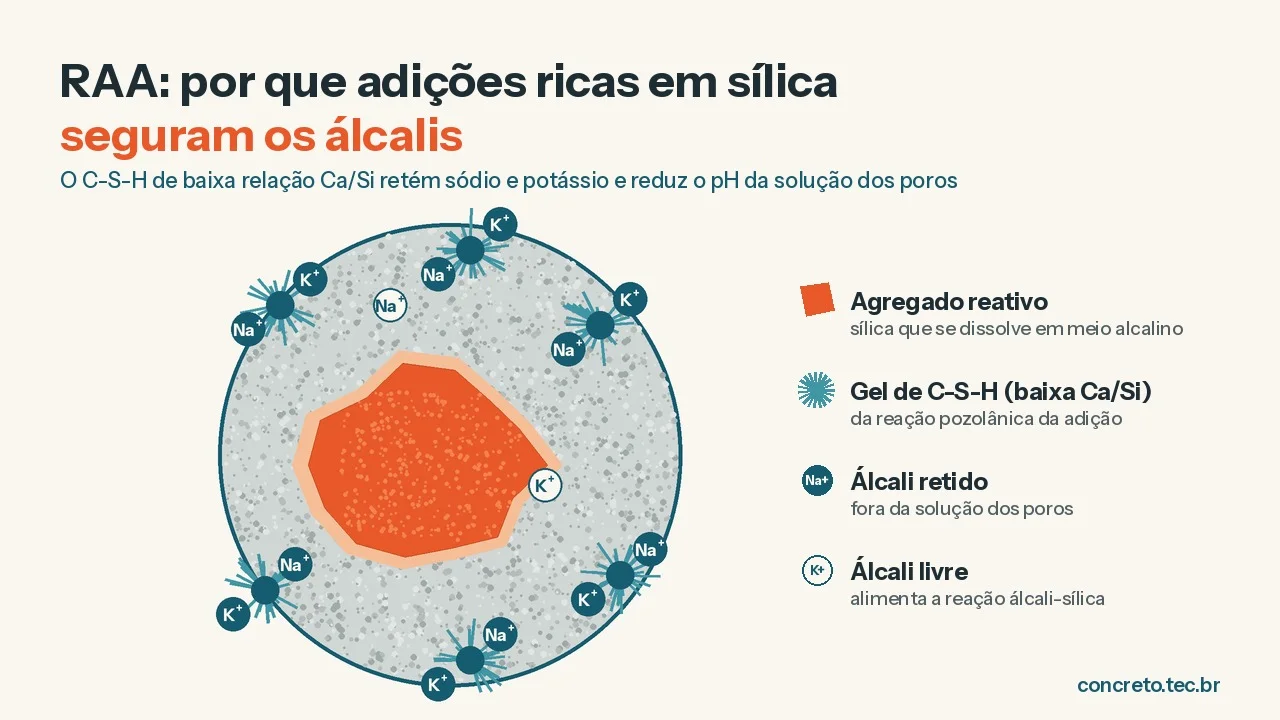
Alkali binding by a low Ca/Si C-S-H. The pozzolanic reaction consumes portlandite and forms additional C-S-H, with a Ca/Si ratio lower than that of the C-S-H from plain cement. Richardson (2008) shows that the structure of C-S-H changes with that ratio and that, at a lower Ca/Si, the silicate chain is longer and the surface carries more sites able to hold cations. Hong and Glasser (1999) measured it directly: the capacity of C-S-H to bind sodium and potassium grows as the Ca/Si ratio falls. Alkali bound in the hydrate is not in the pore solution, and the solution is less aggressive.
A drop in pH and in portlandite. With less free hydroxyl, dissolution of the aggregate silica slows. With less portlandite and less available calcium, the composition of the gel that forms also changes, and so does its ability to expand. The SCM also refines the pores and reduces the mobility of ions and water.
The central point: it is not enough to “have an SCM.” What mitigates is the reactive silica of the SCM, converted into a calcium-poor C-S-H, in a quantity sufficient to bring the pore-solution alkalinity below what that aggregate will tolerate.
Why there is no universal replacement level
Thomas (2011) organizes the trends that the literature and field experience show:
- Silica fume and metakaolin are highly reactive and rich in silica (metakaolin is also rich in alumina). They are often effective at relatively low replacement levels.
- Fly ash varies widely. A low-calcium ash (Class F) tends to be much more effective than a high-calcium ash (Class C). Shehata and Thomas (2000) showed that, as the CaO and the alkalis of the ash rise, the replacement needed to control expansion rises with them.
- Ground granulated blast-furnace slag carries more calcium than the pozzolans and, in general, needs a higher replacement for the same effect.
The level required does not depend only on the SCM. It depends on the reactivity of the aggregate, the alkali content of the cement, the cement content per cubic metre, and alkalis from other sources. The same ash that works with a low-alkali cement and a moderately reactive aggregate may not be enough with a more alkaline cement and a more reactive aggregate. Copying a replacement from one job to another transfers the conclusion without transferring the premises.
Brazilian practice: NBR 15577
ABNT NBR 15577 treats alkali–aggregate reaction in parts. Two matter here.
- NBR 15577-1:2018 is the guide. It classifies the aggregate for reactivity, judges the risk from the exposure and the type of structure, and sets how strong the preventive measures should be. One of those measures is the use of materials that mitigate the reaction, with effectiveness proved by test.
- NBR 15577-5:2018 is the test that proves the mitigation. It is an accelerated mortar-bar method: bars cast with the aggregate of the job and the proposed binder (cement plus SCM) are immersed in an alkaline solution at elevated temperature, and expansion is measured over the days. The result is compared with the criterion of NBR 15577-1. In purpose it is close to ASTM C1567 when the bar includes the SCM, and to ASTM C1260 when the aggregate is tested alone. Duration, solution and expansion limit are not the same, and a result from one does not stand in for the other.
The detail that changes the decision: the test applies to the combination that was tested. Mitigation is proved with the cement and the SCM that will actually go to the job, at the proposed replacement, with the aggregate of the job. Change the cement, the source of the SCM or the quarry, and the earlier result is no longer proof.
A checklist for the job and for quality control
- Aggregate characterized. Is there a reactivity report for the quarry actually in use, and is it recent?
- Risk judged. Was the structure classified under NBR 15577-1 (exposure, moisture, scale, consequence of damage)? Is the level of prevention on record?
- Binder defined and frozen. Cement type and producer, origin and type of the SCM, replacement level.
- Mitigation proved. Is there an NBR 15577-5 test on that exact combination of cement, SCM and aggregate, inside the criterion?
- Traceability of materials. Are the cement and the SCM delivered the ones that were tested? Delivery note and certificate checked on each lot?
- A trigger to retest. A change of cement, of SCM source or of quarry requires a new test before use, not after.
- Alkalis from other sources. Admixtures, water and contaminated aggregates enter the account when the risk is high.
- The record. Report, mix and lots filed with the traceability of the placements. If a crack appears one day, the investigation starts with data.
An open question
The accelerated mortar-bar test is fast and reproducible, but severe conditions shorten the time and change the chemistry. How far do a few weeks in a hot alkaline solution represent decades in a damp foundation block? That is why concrete-prism tests, which are slower, and field monitoring are still discussed. Until that bridge is well built, the prudent course is to test the real combination, with margin, and to treat a change of material as a change of design.
References
- Hong, S.-Y.; Glasser, F. P. Alkali binding in cement pastes. Cement and Concrete Research, v. 29, n. 12, p. 1893–1903, 1999. DOI: 10.1016/S0008-8846(99)00187-8.
- Thomas, M. The effect of supplementary cementing materials on alkali-silica reaction: A review. Cement and Concrete Research, v. 41, n. 12, p. 1224–1231, 2011. DOI: 10.1016/j.cemconres.2010.11.003.
- Richardson, I. G. The calcium silicate hydrates. Cement and Concrete Research, v. 38, n. 2, p. 137–158, 2008. DOI: 10.1016/j.cemconres.2007.11.005.
- Shehata, M. H.; Thomas, M. D. A. The effect of fly ash composition on the expansion of concrete due to alkali–silica reaction. Cement and Concrete Research, v. 30, n. 7, p. 1063–1072, 2000. DOI: 10.1016/S0008-8846(00)00283-0.
- Rajabipour, F.; Giannini, E.; Dunant, C.; Ideker, J. H.; Thomas, M. D. A. Alkali–silica reaction: Current understanding of the reaction mechanisms and the knowledge gaps. Cement and Concrete Research, v. 76, p. 130–146, 2015. DOI: 10.1016/j.cemconres.2015.05.024.
- ABNT. NBR 15577-1:2018 — Aggregates — Alkali-aggregate reactivity — Part 1: Guide for the evaluation of potential reactivity and preventive measures for the use of aggregates in concrete.
- ABNT. NBR 15577-5:2018 — Aggregates — Alkali-aggregate reactivity — Part 5: Determination of the mitigation of expansion in mortar bars by the accelerated method.