
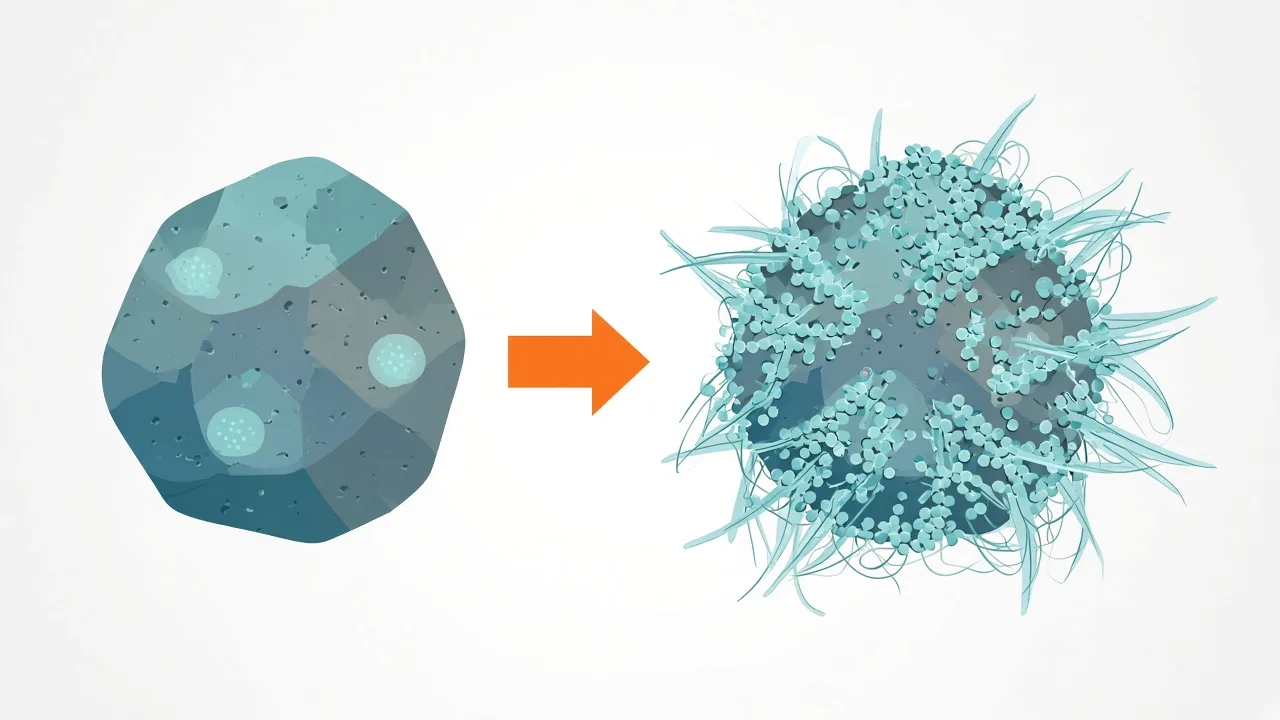
Cutting clinker out of cement is the less invasive way to lower the CO2 of production. The cost shows up in the first hours: hydration slows and early strength drops. The review by John, Matschei and Stephan (2018) treats a calcium silicate hydrate seed — C-S-H — as a nucleation accelerator that can make up part of that loss. The review does not license reading a 24-hour gain as if it were the 28-day concrete.
Why low-clinker cement is slow
Clinker is the fraction that hydrates early. Alite, C3S, governs setting and early strength. Slag and fly ash take the place of part of that clinker, and the reaction rate falls, above all on the first day. The job feels it at demolding, in the precast cycle, and in any member that needs strength before the paste’s own C-S-H has enough nuclei.
The seed does not put the missing clinker back. It offers a surface on which C-S-H can grow sooner. The review is plain about the limit: the delay from supplementary cementitious materials can be compensated only up to a certain replacement, and the direct action of the seed on the SCM itself still needs study.
What the seed is
C-S-H is the main hydrate of alite and belite. A nanoparticle of that hydrate is not just another filler. A filler offers a foreign surface and, sometimes, more room for product to grow. A C-S-H seed is the product itself, and therefore a favorable substrate for further C-S-H.
In practice the seed is added as a gel, in suspension. Powders exist, but an unstabilized gel agglomerates, carbonates and coarsens by Ostwald ripening. Over time the number of effective nuclei falls, and the same mass accelerates less. A pure suspension is stored under inert gas and used soon after it is made. Before it enters the mix it is either stabilized or genuinely homogenized.
The mechanism
Well-dispersed nano-sized C-S-H shortens the induction and dormant periods. The peak rate of hydration is higher and it arrives earlier. Additions from 0.04% to 10% by mass of cement have been studied, and there is a ceiling: past a certain content, more seed does not accelerate further.
What changes place is the formation of the product. The seed works as a secondary nucleus in the pore space. Hydrate grows on it, not only around the clinker grain. With less blocking on the C3S surface, dissolution continues. By taking calcium and hydroxide out of solution, the seed also opens a gradient away from the grain, which can accelerate that dissolution. In cement without slag, aluminate hydration follows: the sulfate-depletion peak moves earlier.
Setting, hardening and the building of the microstructure come after, because the product appears sooner. Several studies gathered in the review describe a more homogeneous, denser stone, with voids filled faster. The crystalline structure seen by diffraction did not change in the cements tested.
In pure C3S the effect on induction is stronger: the induction period has been eliminated, with a shoulder on the heat curve that the review reads as two growth processes in parallel — on the grain and on the seed. In cement, with sulfate, alkalis and aluminate, the picture is a shortening, not the erasure of induction at any dosage.
Early strength is not 28-day strength
Strength rises early because product forms early. The review collects 1-day strength gains on the order of 30% with about 1% of laboratory-made seed, and cases in which raising the dosage past a point reduced the gain. The ceiling depends on the mineralogy of the cement.
The gain is relativized with time. At 28 days the studies the review sets side by side do not agree: a result almost equal to the unseeded paste, a 6% gain in one Portland cement, and a 12% loss in another set. The authors agree on one point: the early advantage shrinks.
One figure sizes the hurry. In a paste with 0.6% of a C-S-H/PCE composite, 18% less clinker remained at 12 hours than in the unseeded paste. By 3 days the difference had fallen to 5%. A control that stops at 24 hours measures the stretch where the seed shows most.
Slag and fly ash do not repeat plain cement
In cement blended with ground granulated blast-furnace slag, the review finds the same acceleration and the same early-strength gain. The long-term compressive strength of the seeded pastes was lower than that of the unseeded pastes. That is where the optimistic summary — compensate the delay without compromising later strength — does not hold for these systems.
There is a second departure. In cement without slag, the sulfate-depletion peak moves earlier. In cement with slag, that peak moves later when the seed is present.
Fly ash draws a different picture. The effect of the seed on early strength is greater than in plain cement, and the effect on the rate of hydration is smaller. The review does not extend to fly ash the loss of later strength recorded for slag.
What decides is the number of nuclei
The mass on the batch ticket is a poor summary. In the series with C-S-H and polycarboxylate composites, the same mass of smaller particles accelerated more. The review closes the argument: the decisive factor is the total number of seeds, whether by particle count or by size.
Dispersion and stability sit inside that account, not beside it. An agglomerated seed is fewer nuclei for the same mass. A seed that has ripened on the shelf is fewer nuclei too. A dosage copied from another study, with another size and another stability, is not the same dosage.
Cement composition weighs as much as the seed. Sulfate and alkalis are the parameters Nicoleau, in the review’s reading, singles out. Too little sulfate or alkali can annihilate the first nuclei and open a plateau with no acceleration. Gypsum content shifts the ceiling: with less gypsum, more seed is needed to reach the plateau, and a second acceleration can appear after it. A finer cement, with more C3S surface, accelerated less at the same seed content. Hydration is not nucleation alone. C3S dissolution stays in charge.
The Ca/Si ratio of the seed is still open. Opposite results appear in cement and in C3S, and some of them used ratios outside the field in which C-S-H is the only phase. Silica or calcium hydroxide remains, particle size was not measured, and the comparison is no longer one of Ca/Si alone.
PCE is not a detail of synthesis
Coprecipitating C-S-H with a polycarboxylate superplasticizer is the route used to lock particle size and hold back agglomeration. Polymer on the surface, and its desorption, changes how the seed performs. The review treats this as an extra mechanism, which gets in the way of anyone trying to isolate the effect of pure C-S-H.
In the mix, the consequence is practical. A seed made with PCE and the PCE admixture of the job do not add as two independent lines. The test that counts is the one with the cement, the SCM and the admixtures that will actually be used.
What to measure
- The real cement and SCM. Sulfate, alkalis, fineness and the SCM change the response. A change of cement, or of slag or fly-ash source, reopens the study.
- The seed as it arrives. A stable suspension, or one homogenized at the time of use. Check that the dispersion is still the one that was tested.
- The curve, not the 24-hour point. Strength at 1, 3, 7 and 28 days. The review already shows the picture changing between 12 hours, 3 days and 28 days. Day 7 is the intermediate age a job-site control does not skip.
- Precast. The age that shortens the cycle is the demolding age. The 28-day result stays in the acceptance. A gain at demolding is not entered as the specified strength.
- A dosage ceiling. Above it, more seed can accelerate less, and the strength gain can fall. The ceiling belongs to the cement that was tested, not to a table.
A C-S-H seed is a nucleation tool for a cement that has become slow because it has less clinker. It works early, it depends on how many nuclei actually enter the paste, and it does not excuse a reading through 28 days — especially when the SCM is slag.
References
- John, E.; Matschei, T.; Stephan, D. Nucleation seeding with calcium silicate hydrate – A review. Cement and Concrete Research, v. 113, p. 74–85, 2018. DOI: 10.1016/j.cemconres.2018.07.003. Accepted open-access version: 10.14279/depositonce-15352.