
The bottleneck for LC3 is characterizing the clay. The reference proportion is already published. What decides whether the blend comes close, in strength, to ordinary Portland cement is the kaolinite content of the clay on hand, and that content is measured.
What LC3 is
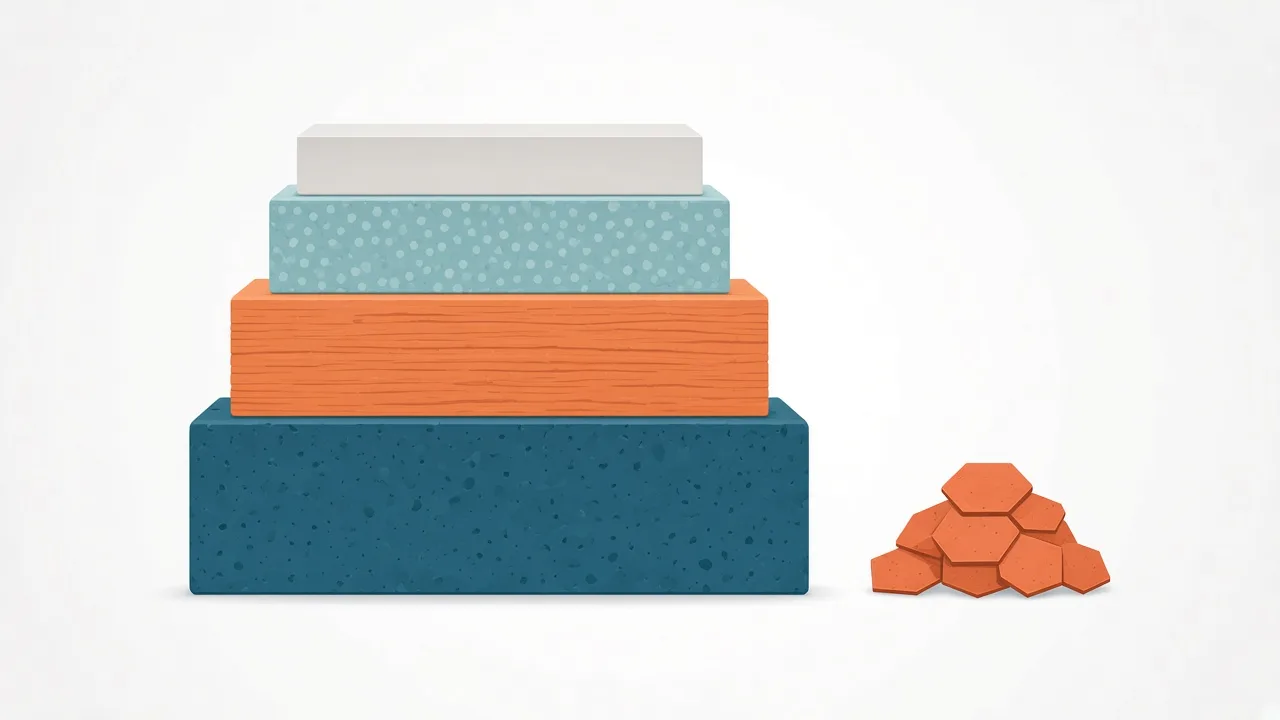
LC3 is limestone calcined clay cement. In the formulation of Scrivener, Martirena, Bishnoi and Maity (2018), the material brings together ground clinker, calcined clay, limestone and gypsum. The reference, LC3-50, is 50% clinker, 30% calcined clay, 15% limestone and 5% gypsum. The number in the name is the clinker content. At that composition, the paper reports mechanical properties similar to those of ordinary Portland cement.
The replacement is coupled. Calcined clay comes in as a pozzolan and limestone comes with it. Limestone on its own, at a high replacement, tends to raise porosity. Together, the two carry the clinker content of the reference blend.
The mechanism in the same paper is short. Calcining a kaolinitic clay forms metakaolin, an amorphous aluminosilicate. Metakaolin reacts with calcium hydroxide as a pozzolan and yields C-(A)-S-H and aluminate hydrates. The alumina also reacts with the limestone and forms carboaluminate hydrates. Those products fill space and contribute to strength.
The role of kaolinite
The reactivity of the calcined clay depends above all on the kaolinite content. In LC3-50, clays with about 40% kaolinite gave strengths comparable to the reference cement from about 7 days, in mortars tested to EN 196-1. Clays in that range are widely distributed. Because clay is already a raw material of cement manufacture, the paper notes that they may even sit in a plant’s existing quarry.
EN 196-1 is the European test of cement-mortar strength, run on prisms. ABNT NBR 7215 asks a similar question in Brazil, on cylinders. The procedures do not match, and a result from one does not stand in for the other.
In practice
The 50/30/15/5 recipe does not characterize the clay. Two clays can take the same place in the blend and carry quite different kaolinite contents. The strength of LC3 follows that content.
- Measure the kaolinite in the clay that is available. That is the figure the paper treats as dominant. Without it, a comparison with the reference cement has no basis.
- Test the real materials. The clinker, calcined clay, limestone and gypsum of the combination that will be used. The comparable strength cited above was read on EN 196-1 mortar, from about 7 days, on clays with about 40% kaolinite. Another clay, or another clinker, reopens the test.
The LC3 project, run by EPFL with the Swiss Agency for Development and Cooperation (SDC), reports on the project site a reduction in CO2 emissions of up to 40%. The source of that figure is the project site, lc3.ch.
References
- Scrivener, K.; Martirena, F.; Bishnoi, S.; Maity, S. Calcined clay limestone cements (LC3). Cement and Concrete Research, v. 114, p. 49–56, 2018. DOI: 10.1016/j.cemconres.2017.08.017.
- LC3 Project. École polytechnique fédérale de Lausanne (EPFL) and the Swiss Agency for Development and Cooperation (SDC). lc3.ch.
- Cancio Díaz, Y.; Sánchez Berriel, S.; Heierli, U.; Favier, A. R.; Sánchez Machado, I. R.; Scrivener, K. L.; Martirena Hernández, J. F.; Habert, G. Limestone calcined clay cement as a low-carbon solution to meet expanding cement demand in emerging economies. Development Engineering, v. 2, p. 82–91, 2017. DOI: 10.1016/j.deveng.2017.06.001. Complementary reading, open access.