
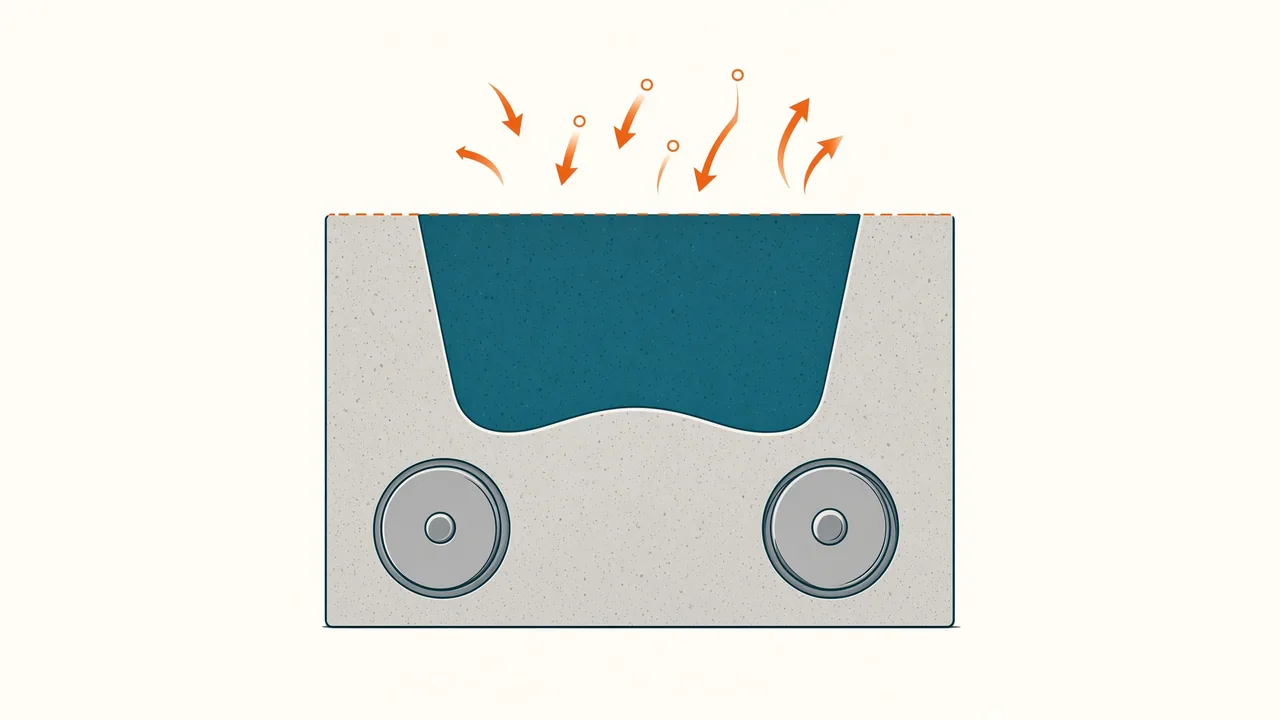
Meeting the specified compressive strength, the fck, does not settle the service life of a reinforced concrete structure. The 28-day strength describes the concrete that came out of the mix design and the control. The carbonation front also depends on the cement, any mineral addition, the exposure, the humidity and the CO2 in the air. In Possan’s 2010 model, the 28-day strength sits beside those variables.
How the front reaches the steel
Carbon dioxide from the air enters through the pores of the cover. In the presence of moisture it reacts with the hydration products of the cement and lowers the pH of that layer. While the concrete around the bar stays alkaline, the steel is protected by chemical passivation. When the carbonation front reaches the steel, that passivation ends and corrosion can start.
Possan (2010) describes the same path. The front starts at the surface and moves inward. The distance the CO2 has to travel is the cover. Once it reaches the reinforcement, the steel is depassivated and open to corrosion. In the thesis, that moment closes the initiation period and is the reference for design service life. Visible deterioration, when it happens, comes later.
Possan’s model
In 2010 Edna Possan defended, in the graduate program in civil engineering at the Federal University of Rio Grande do Sul (PPGEC/UFRGS), the thesis Modelagem da carbonatação e previsão de vida útil de estruturas de concreto em ambiente urbano (Modelling of carbonation and service-life prediction of concrete structures in an urban environment). The catalog record lists Denise Carpena Coitinho Dal Molin as advisor and Jairo José de Oliveira Andrade as co-advisor. The full text is on Lume, lume.ufrgs.br/handle/10183/28923.
The abstract proposes a mathematical model to estimate carbonation depth and to predict the design service life of concrete structures in an urban environment. The inputs are variables that are relatively straightforward to obtain. The abstract groups them as follows:
- the concrete: compressive strength at 28 days, cement type, and addition content, where there is one;
- the exposure: indoors or outdoors, sheltered from rain or not;
- the environment: mean relative humidity of the region and the CO2 content of the air.
The database behind the model came from expert knowledge, gathered in a focus group. The fit took the relevant physicochemical laws into account and was checked against experimental data from other researchers. The abstract reports that the model represents concrete carbonation and can be generalized. It can be used on a new or an existing structure, for carbonation depth or for design service life, with a deterministic or a probabilistic reading.
For the design service life, the thesis uses Monte Carlo simulation and a reliability analysis, so that the variability of the degradation process is part of the estimate. The equation and the coefficients are in the thesis.
The 28-day strength is one input. Cement, addition, exposure, humidity and ambient CO2 come with it. Concrete that meets the specified fck still needs that set before an estimate of the front means anything.
In practice
- Specify from the aggressiveness class. ABNT NBR 6118 is the Brazilian standard for the design of concrete structures. It organizes design durability by the environmental aggressiveness class. Cover and concrete quality are what the design declares from that class. The values stay in the current edition.
- Build the cover that was specified. The front advances through the concrete that ended up in the member. A cover thinner than specified shortens the path of the CO2 to the steel.
- Cure the surface. The thesis counts curing among the execution factors that change the porosity and the permeability of the cover, and with them the ease with which CO2 gets in. The surface is the way in. Curing it belongs with the protection of the reinforcement, with the aggressiveness class and with the cover that was built.
References
- Possan, E. Modelagem da carbonatação e previsão de vida útil de estruturas de concreto em ambiente urbano. 2010. Thesis (D.Eng.) — Programa de Pós-Graduação em Engenharia Civil, Universidade Federal do Rio Grande do Sul, Porto Alegre. Advisor: Denise Carpena Coitinho Dal Molin. Co-advisor: Jairo José de Oliveira Andrade. lume.ufrgs.br/handle/10183/28923.
- ABNT. NBR 6118 — Design of concrete structures. Consult the current edition. The standard links the environmental aggressiveness class to cover and to concrete quality. Table values stay in the standard.