
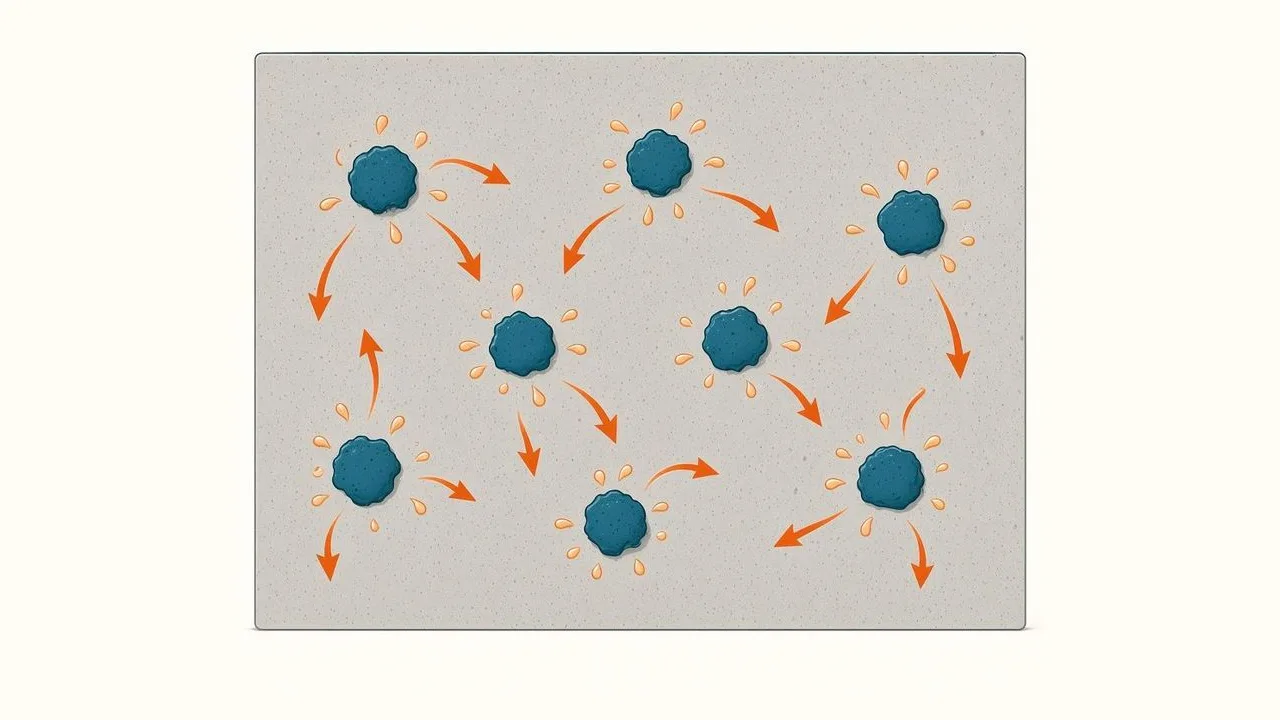
A concrete can crack without losing water to the surroundings. In a mix of low water–cement ratio, hydration consumes the pore water, the internal relative humidity falls and the paste contracts. That contraction is autogenous shrinkage. It happens even when no water is lost to the outside.
Self-desiccation
The water hydration consumes is the water in the pores. With less free water inside, the relative humidity of the paste drops. That drop, with no exchange with the outside air, is self-desiccation. The paste contracts. Evaporation, wind and an exposed face are not required. The reaction is enough.
A member protected from drying can still shorten. A measurement that only records water lost to the surroundings does not see this mechanism.
What external curing reaches
External curing wets the surface or keeps the surface from losing water. In a very closed matrix, water from the outside penetrates little. The interior goes on with self-desiccation almost without that supply.
External curing remains mandatory all the same. Helping little, in this mix, does not excuse it.
Internal curing with SAP
Jensen and Hansen (2001) set out the principle of water-entrained concrete. A superabsorbent polymer, SAP, absorbs water during mixing and forms water-filled macroinclusions distributed through the mass. Those inclusions feed the paste and prevent self-desiccation. The curing water is already spread through the interior. That is internal curing.
Jensen and Hansen (2002) continue the same work, as part II, with experimental observations.
In practice
- Include autogenous shrinkage in the mix-design study of high-performance concrete. A study that closes only on strength and consistency misses the contraction a low water–cement mix can have without drying to the outside. Autogenous shrinkage enters that study, with the materials that will go on the job.
- Keep external curing. Internal curing does not replace it. Water from the outside penetrates little, and curing of the surface remains mandatory.
A crack in low water–cement concrete is not always water that evaporated. It can be the paste that hydration itself dried from the inside.
References
- Jensen, O. M.; Hansen, P. F. Water-entrained cement-based materials: I. Principles and theoretical background. Cement and Concrete Research, v. 31, n. 4, p. 647–654, 2001. DOI: 10.1016/S0008-8846(01)00463-X.
- Jensen, O. M.; Hansen, P. F. Water-entrained cement-based materials: II. Experimental observations. Cement and Concrete Research, v. 32, n. 6, p. 973–978, 2002. DOI: 10.1016/S0008-8846(02)00737-8.