
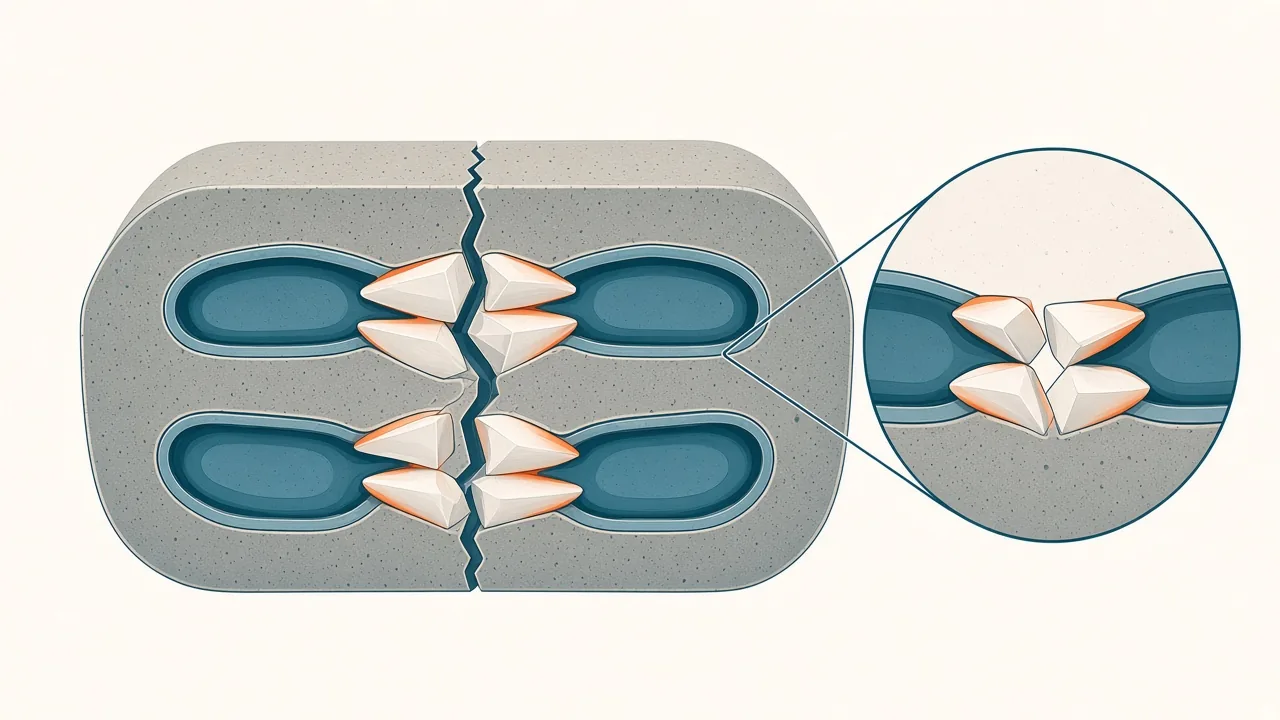
Bacterial self-healing of concrete has already been measured in the laboratory. The question is under what condition the calcium carbonate seals the crack.
The mechanism
In the TU Delft line, spores of bacteria that resist the alkaline environment, and a nutrient, calcium lactate, are incorporated into the concrete. When the crack opens and water enters, the bacteria activate and precipitate calcium carbonate, which seals the crack.
Jonkers et al. (2010) present the application of bacteria as a self-healing agent. The paper is the context of that research line. The sealed width that follows is from Wiktor and Jonkers (2011).
The Wiktor and Jonkers test
Wiktor and Jonkers (2011) protected the spores and the nutrient in porous expanded-clay particles. The particles hold the agent inside the concrete. Water that enters through the crack releases that agent, and the bacterially mediated precipitation of calcium carbonate seals the crack.
After 100 days immersed in water, cracks up to 0.46 mm were sealed in the concrete with bacteria. In the control, the sealed width reached 0.18 mm.
Both widths come from this test: expanded clay, immersion and 100 days.
In practice
- Treat it as promising where water and a fine crack are present. Reservoirs and buried structures are that case. Water can reach the crack, and the test deals with cracks of that order, up to 0.46 mm.
- Keep mix design, curing and detailing as the first defence. The test measures sealing after the crack exists, with the specimen immersed. The mix, the curing of the young member and the detailing that limits the crack come first.
Calcium carbonate seals a fine crack when the agent is protected in expanded clay and the water remains. The value 0.46 mm is the one from this test, at 100 days.
References
- Wiktor, V.; Jonkers, H. M. Quantification of crack-healing in novel bacteria-based self-healing concrete. Cement and Concrete Composites, v. 33, n. 7, p. 763–770, 2011. DOI: 10.1016/j.cemconcomp.2011.03.012. Record: TU Delft.
- Jonkers, H. M.; Thijssen, A.; Muyzer, G.; Copuroglu, O.; Schlangen, E. Application of bacteria as self-healing agent for the development of sustainable concrete. Ecological Engineering, v. 36, n. 2, p. 230–235, 2010. DOI: 10.1016/j.ecoleng.2008.12.036.