
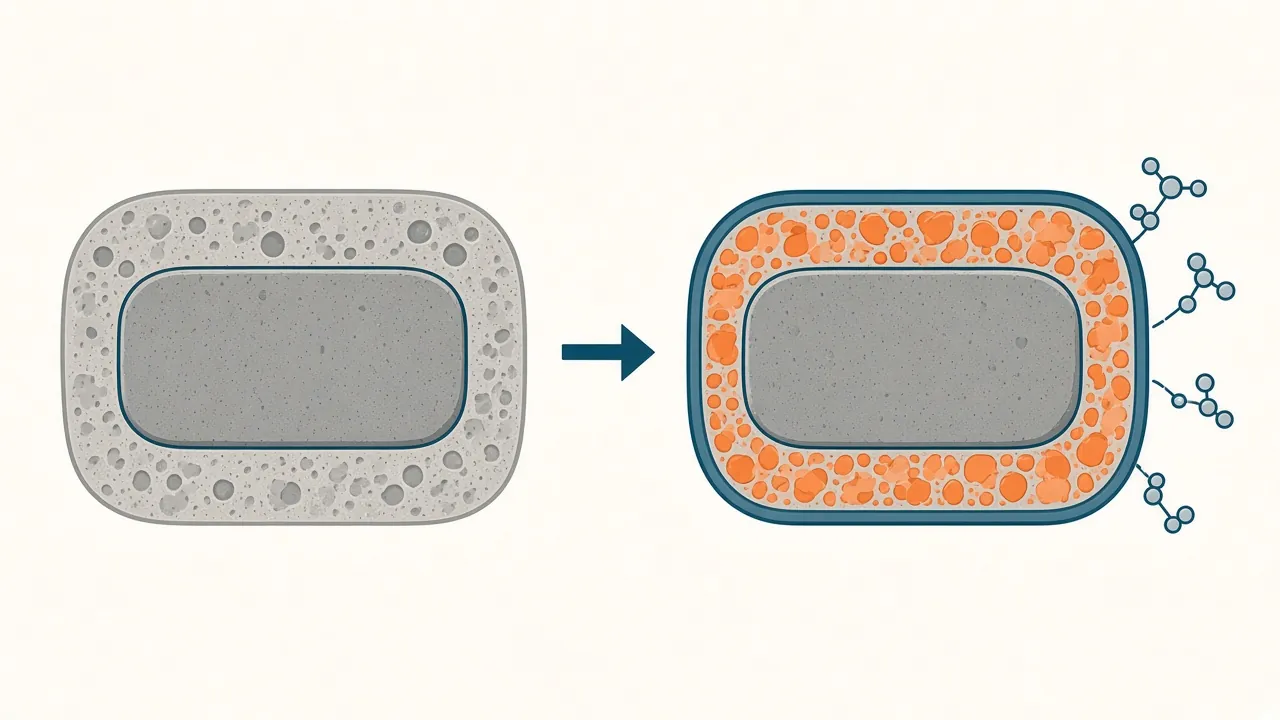
The weak point of recycled concrete aggregate is not the rock. It is the old mortar adhered to it.
That old paste is porous and absorbs a lot of water. In the new concrete, water that the mortar takes from the mix is no longer available to the fresh paste. The effective water–cement ratio shifts: what was batched is not what the new paste receives.
The mechanism
One route that has been studied is accelerated carbonation. The aggregate is exposed to CO₂ so that calcium compounds in the adhered paste, calcium hydroxide and C-S-H, convert to calcium carbonate. The carbonate precipitates in the pore space and fills it.
What Zhan and co-authors measured
Zhan, Poon, Liu, Kou and Shi (2014), at the Hong Kong Polytechnic University, produced recycled aggregate in the laboratory. Hardened concretes, prepared with different water–cement ratios, were crushed to different particle sizes. Before and after CO₂ curing, they measured water absorption and density.
Carbonation reduced the water absorption and increased the density. The properties of the aggregate improved. The result depends on curing time, particle size and the moisture content of the aggregate. The extent of the curing was quantified by the carbonation percentage of the aggregate: part of the CO₂ stays fixed in it.
In practice
- Measure the water absorption of the recycled aggregate and allow for it when adjusting the mixing water. The adhered mortar takes water from the mix. Without that absorption in the calculation, the effective water–cement ratio of the new paste is not the one the mix design closed.
- Control the moisture of the aggregate. Pre-saturation, when the mix provides for it, sets how much water the aggregate can still take. Moisture is also one of the variables of the CO₂ curing in the test by Zhan and co-authors: the effect they measured depends on that condition.
The rock in the recycled aggregate is not what upsets the new concrete. It is the old, porous mortar. Accelerated carbonation aims to fill that mortar with calcium carbonate.
References
- Zhan, B.; Poon, C. S.; Liu, Q.; Kou, S.; Shi, C. Experimental study on CO2 curing for enhancement of recycled aggregate properties. Construction and Building Materials, v. 67, p. 3–7, 2014. DOI: 10.1016/j.conbuildmat.2013.09.008. Record: PolyU.