
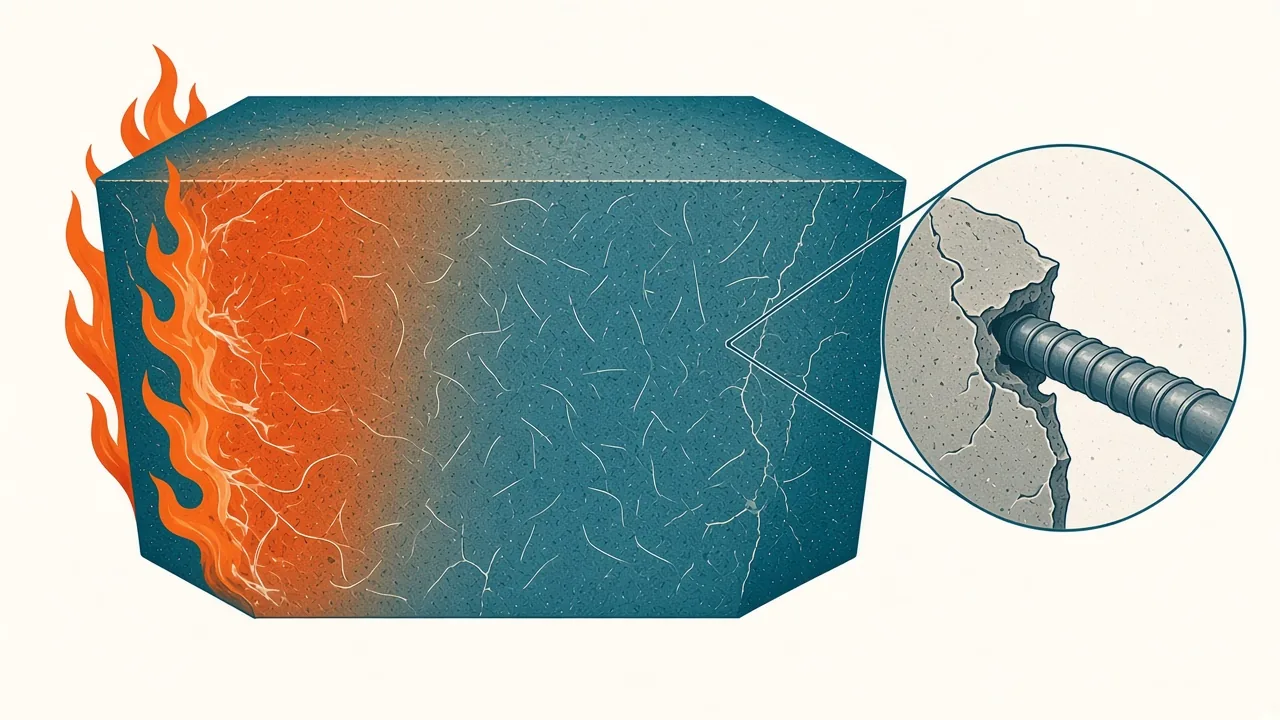
A polypropylene fibre dose, in kilograms per cubic metre, is not enough to protect high-performance concrete in a fire. The dense matrix makes it hard for vapour to escape. Pore pressure rises, and layers can break away explosively, exposing the reinforcement. Fibre type and geometry belong in that protection together with the mass.
Vapour pressure
On heating, the water in the pores turns to vapour. In high-performance concrete the matrix is dense, and the vapour has difficulty getting out. Pressure inside the pores rises. When that pressure is not relieved, surface layers can break away explosively. That detachment is spalling. The cover is lost, and the reinforcement is left exposed to the fire.
What the polypropylene fibre does
Kalifa, Chéné and Gallé (2001) measured pore pressure in heated specimens of high-performance concrete, with polypropylene fibres and without them. The fibres produced a large decrease in the pressure fields that build up in the pore network during heating. The effect was also significant at dosages below the theoretical percolation threshold.
Permeability measurements, after heat treatments and for several dosages, showed the effect of the fibres from 200 °C upward, close to the melting temperature. The fibres create permeable paths. The vapour gains a way out, and the pore pressure falls.
The limit of guidance by dose
Maluk, Bisby and Terrasi (2017) varied, in high-performance concretes, the polypropylene fibre type, the cross-section, the length and the dose. The dose, as the mass of PP per cubic metre of fresh concrete, is the parameter that design guidance prescribes. The cross-section and the length of each fibre can also have a considerable influence on how effective the fibres are against spalling. The guidance in force was insufficient to prevent spalling in the high-performance concretes tested.
European guidance for concrete in fire, EN 1992-1-2, as cited by those authors, recommends at least 2 kg of monofilament PP fibre per cubic metre for high-strength concrete with a high moisture content and/or a high silica-fume content. Cross-section and length sit outside that prescription by dose. In the concretes they tested, the guidance did not prevent spalling.
In practice
- Specify the fibre type and geometry. The specification states whether the fibre is monofilament, what the cross-section is and what the length is, together with the dose in kg/m³. Mass alone leaves out what Maluk, Bisby and Terrasi measured as an influence.
- Test a representative concrete when that is possible. The mix, the moisture and the heating expected for the member go into the test. Guidance by dose did not replace that test for the high-performance concretes they studied.
Polypropylene fibre relieves vapour pressure by opening a path through the matrix. The kilogram per cubic metre does not, on its own, describe what that path is.
References
- Kalifa, P.; Chéné, G.; Gallé, C. High-temperature behaviour of HPC with polypropylene fibres: From spalling to microstructure. Cement and Concrete Research, v. 31, n. 10, p. 1487–1499, 2001. DOI: 10.1016/S0008-8846(01)00596-8.
- Maluk, C.; Bisby, L.; Terrasi, G. P. Effects of polypropylene fibre type and dose on the propensity for heat-induced concrete spalling. Engineering Structures, v. 141, p. 584–595, 2017. DOI: 10.1016/j.engstruct.2017.03.058. Accepted version: Maluk, Bisby and Terrasi, 2017.